
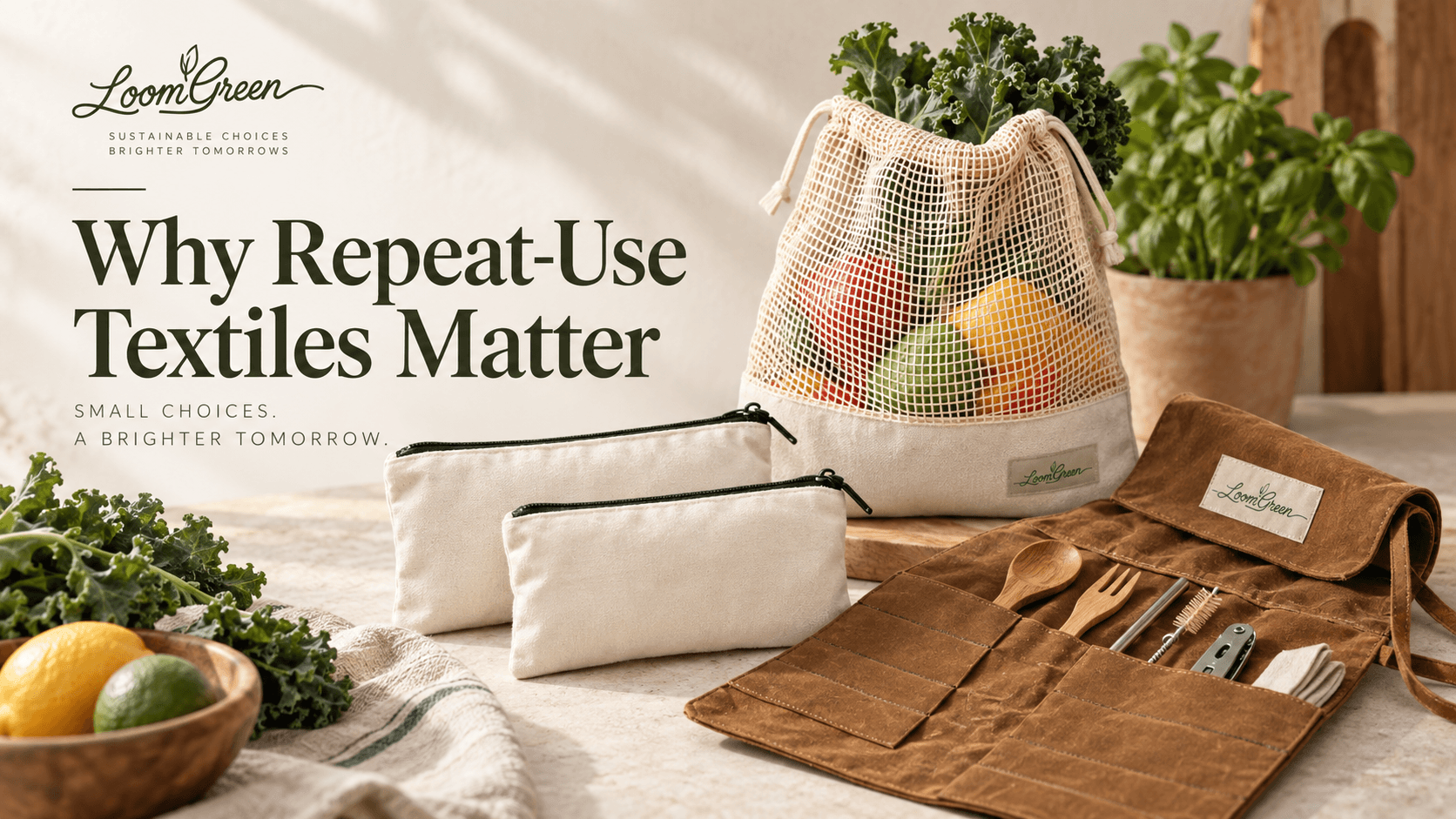
A reusable product is only useful if people actually keep using it.
That sounds obvious, but many everyday products described as reusable are not designed around repeated handling. A lightweight bag may lose its shape. A poorly constructed pouch may develop problems around the zipper or seams. An organizer may work well when new but become less practical once it has been filled, carried, emptied and used repeatedly.
That is why we think repeat-use textiles should be judged differently.
The important question is not simply whether a product can be reused. It is whether its material, construction, size and function make repeated use practical enough that it naturally becomes part of an everyday routine.
What Does “Repeat-Use” Actually Mean?
For Loom Green, repeat-use is a practical design principle rather than a marketing label.
A repeat-use textile product should be made for regular handling. Depending on its intended purpose, that can mean carrying weight, being folded and stored, opening and closing repeatedly, being washed when appropriate, or protecting and organizing items day after day.
Different products face different stresses.
A cotton mesh bag used for pantry or produce organization does not need the same construction as a waxed canvas tool roll. A cotton zipper pouch has different requirements again.
The material and construction therefore need to match the job.
That distinction matters because “reusable” on its own says very little about how useful a product will actually be after it leaves the package.
Why Durability Matters for Reusable Products
When a reusable product becomes inconvenient, unreliable or difficult to use, people tend to stop reaching for it.
Consider a reusable storage bag. If its seams begin to separate or its closure becomes awkward, it may eventually be replaced by whatever alternative is easiest.
The same principle applies to an organizer. If compartments stretch excessively, stitching fails at heavily loaded areas or the product is simply the wrong size for the items it is supposed to carry, its usefulness declines.
For this reason, durability is closely connected to functionality.
A repeat-use product does not need to be indestructible. It does need to be appropriately designed for the type of handling it is expected to receive.
Good construction helps preserve the reason the product was purchased in the first place.
What Makes a Textile Product Suitable for Repeat Use?
Several design decisions have a large influence on whether a textile product remains useful over time.
1. Materials Matched to the Job
There is no single “best” reusable fabric.
The right material depends on the function.
Cotton mesh can be useful where breathability, visibility and lightweight storage matter. Heavier canvas can provide more structure for carrying and organizing equipment. Waxed canvas can be appropriate where a tougher outer surface and some resistance to moisture are useful.
Material selection should therefore begin with a simple question:
What does this product actually need to do?
Selecting a fabric because it sounds sustainable or looks attractive is not enough. Its weight, structure, flexibility, breathability and intended care all need to make sense for the application.
2. Construction at Stress Points
Fabric is only one part of durability.
A strong material can still produce a weak product if the construction is inappropriate.
Areas around handles, pocket openings, closures, drawstrings and other load-bearing points often receive more stress than the rest of a product. Stitching, seam construction and reinforcement should reflect that.
Closures matter as well.
A zipper pouch is only useful while the zipper continues to perform its function. A drawstring bag needs a closure that remains convenient to operate. An organizer needs pockets and seams capable of supporting their intended contents.
Repeat-use design considers the complete product rather than fabric alone.
3. Practical Sizing
A surprisingly important part of durability is simply making the product useful enough that someone wants to keep using it.
Sizing affects that.
A reusable bag that is consistently too small, an organizer that cannot accommodate common items or a pouch that is unnecessarily bulky can quickly become inconvenient.
Products fit more naturally into routines when their dimensions reflect how people actually store, carry and organize things.
Practical sizing is therefore not just a specification on a product page. It is part of the product’s overall function.
4. Simple, Useful Features
Repeat-use products rarely need excessive complexity.
In many cases, straightforward features are more valuable: a functional closure, clearly sized compartments, easy storage, sensible handles or construction that allows the product to fold away when not needed.
Every added feature should have a reason to exist.
At Loom Green, we prefer products that are easy to understand and easy to incorporate into everyday routines rather than adding features simply to make a specification list longer.
Repeat Use Is Different From Single Use
Single-use and disposable products are generally optimized for a short service life. That can make sense for certain applications, but it creates a very different design brief.
A repeat-use textile product has another objective.
It has to remain useful after the first use.
That shifts attention toward fabric selection, seam construction, closures, dimensions, workmanship and care.
There can also be a simple economic consideration. A product that remains useful for repeated tasks may reduce the need to repeatedly purchase disposable or short-lived alternatives.
However, the calculation depends on the product, how often it is used and how long it remains in service.
That is why we prefer to focus on practical product performance rather than broad environmental promises.
A Practical Approach to Reusable Textiles
Reusable products are often discussed primarily in environmental terms.
We think there is another useful way to look at them.
A well-designed reusable textile can simply be a better tool for a recurring job.
A cotton mesh bag can keep pantry items grouped while remaining easy to see through. A reusable cotton zipper pouch can keep small accessories together instead of leaving them loose in a drawer or bag. A canvas tool organizer can provide defined storage for equipment that would otherwise be scattered or difficult to transport.
In each case, repeat use comes from usefulness.
If the product solves a recurring problem and continues performing that function, people have a reason to keep it in regular rotation.
That is a stronger foundation for reusable design than asking someone to use a product repeatedly simply because it has been described as environmentally friendly.
What Repeat-Use Design Means at Loom Green
Our approach starts with the intended use of the product.
We consider questions such as:
- What will the product carry or organize?
- How will it normally be handled?
- Where are the likely stress points?
- What fabric characteristics does the application require?
- What type of closure makes sense?
- What dimensions are practical?
- How easy is the product to store and use again?
Those questions influence material selection, stitching, reinforcement, sizing and finishing across our range.
The objective is straightforward: create textile goods with a clear purpose that are practical enough to keep using.
That philosophy applies whether we are developing reusable mesh bags for household organization, cotton zipper pouches for smaller essentials or canvas products for tools and everyday work.
A useful product earns its place through repeated use — not simply through how it looks when it is first unboxed.
Better Products Start With Better Questions
The most useful question about a reusable textile is not:
“Is this reusable?”
Almost anything can technically be used more than once.
A better question is:
“Has this been designed in a way that makes me want to keep using it?”
That brings the focus back to the things that matter: materials, construction, function, sizing and everyday practicality.
Those are the characteristics that turn a reusable product into a genuinely repeat-use product.
Browse the Loom Green product collection
to see our range of practical cotton, mesh and canvas goods, explore our
cotton zipper pouches,
or read our guide on
how to organize a pantry with reusable mesh bags
for a practical example of repeat-use design in everyday organization.