
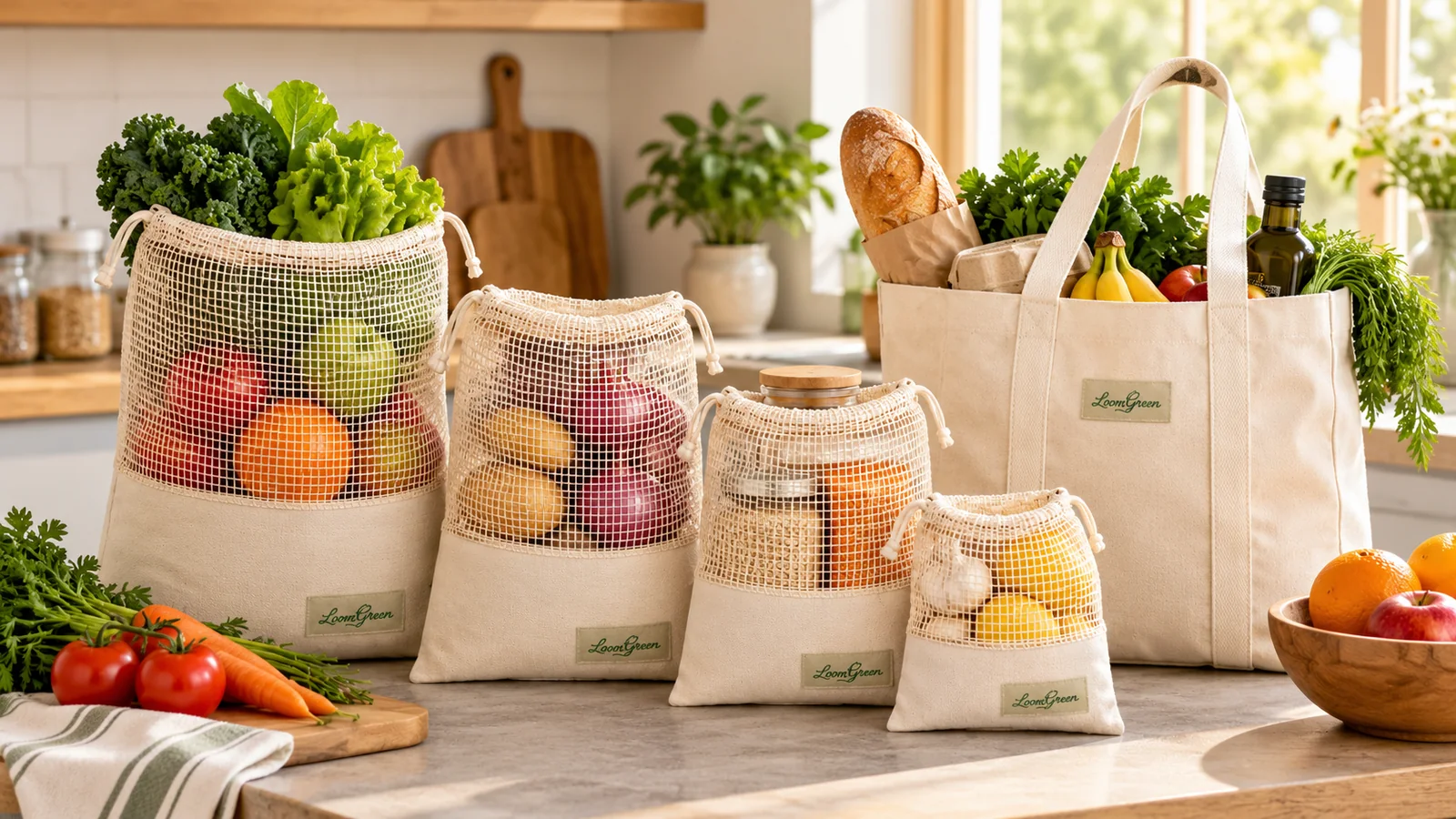
Switching to reusable grocery bags sounds simple: keep a few bags in the car, take them into the store, and stop reaching for disposable bags at checkout. In practice, grocery shopping involves more than one type of bag.
A large checkout tote is designed to carry your groceries home. A reusable produce bag has a different purpose: keeping fruits, vegetables, bread, or other smaller grocery items together while you shop.
Understanding that difference makes it much easier to build a reusable grocery bag system that you will actually remember to use.
This starter guide explains the difference between reusable produce bags and checkout totes, what features to look for, how many bags you actually need, and how to keep your reusable shopping system simple.
Reusable Grocery Bags Are Not All Designed for the Same Job
One of the easiest mistakes when switching to reusable bags is expecting one bag style to handle every stage of a grocery trip.
There are really two separate jobs:
- Produce and small-item organization inside the store
- Carrying the complete grocery load home
Those jobs require different designs.
A large shopping tote should have enough structure and carrying capacity for heavier grocery items. A produce bag should be lighter, easier to pack inside another bag, and appropriately sized for individual grocery categories.
Checkout Totes vs. Reusable Produce Bags
What Is a Checkout Tote For?
A checkout tote is the bag you use after your groceries have been scanned. Its job is to carry the combined weight of packaged foods, pantry items, bottles, produce, and other purchases from the store to your vehicle or home.
For this job, carrying capacity, handle construction, and overall durability matter.
A checkout tote should generally be large enough that you do not need an excessive number of bags but not so large that it becomes uncomfortable when fully loaded.
What Is a Reusable Produce Bag For?
A reusable produce bag is normally used inside the store for individual groups of fruits, vegetables, bread, dry bulk goods, or other smaller items.
Unlike a checkout tote, it should fold easily and occupy very little space before you begin shopping.
Mesh construction is particularly convenient because it allows you to see much of the contents without opening the bag.
The two types of bags therefore complement each other rather than compete with each other.
Why Cotton Mesh Works Well for Produce Bags
Cotton mesh gives a reusable produce bag several practical characteristics.
The open construction keeps the contents visible, which makes it easier to identify what is inside when several bags are sitting together in your cart, pantry, or shopping tote.
The flexible fabric also allows the bag to fold relatively flat between uses.
That matters because a reusable shopping system is only useful if it is convenient enough to carry with you.
The Loom Green Reusable Drawstring Mesh Bags, for example, combine a cotton mesh upper with a canvas base. The mesh keeps much of the contents visible, while the canvas base provides additional structure at the bottom of the bag.
Why the Canvas Base Matters
Not every part of a reusable grocery bag has to use the same fabric.
A combination of mesh and solid canvas can provide a useful balance.
The mesh upper keeps the bag flexible and makes it easier to see what is inside, while a canvas base provides a more substantial bottom section for the contents to rest against.
This can be particularly helpful when carrying items such as:
- Potatoes
- Onions
- Apples
- Oranges
- Carrots
- Other relatively substantial produce items
The important point is not that a canvas base makes a bag indestructible. It simply gives the lower portion of the bag more structure than an entirely open mesh construction.
Why a Drawstring Closure Is Useful
A reusable produce bag also needs a practical way to keep its contents together.
A drawstring closure allows the opening to be tightened after the bag has been filled.
This is useful when the bag moves between:
- Your shopping cart
- The checkout counter
- Your larger grocery tote
- The car
- Your kitchen or pantry
Without a closure, small produce items can more easily move around inside a larger shopping bag.
Choose Different Bag Sizes Instead of One Universal Size
A good reusable grocery setup should include more than one bag size.
A bag suitable for several potatoes is unnecessarily large for a few garlic bulbs. At the same time, a very small produce bag is not particularly useful for a larger quantity of fruit or vegetables.
A multi-size system allows you to choose the bag according to the purchase rather than forcing every grocery item into the same format.
Large and Extra-Large Bags
Use larger bags for bulkier quantities such as:
- Potatoes
- Onions
- Apples
- Oranges
- Larger vegetables
- Bread or bakery items when appropriate
Medium Bags
Medium reusable produce bags work well for the categories most people buy regularly:
- Tomatoes
- Lemons
- Avocados
- Small quantities of fruit
- General grocery organization
Small Bags
Small bags can be useful for:
- Garlic
- Ginger
- Small citrus
- Herbs when appropriate
- Other compact grocery items
There is no requirement to use a particular size for a particular food. The goal is simply to avoid carrying a large bag when a smaller one will do the job.
How Many Reusable Grocery Bags Do You Actually Need?
You do not need a drawer full of reusable bags to get started.
For many households, a practical starter system might consist of:
- 1–2 larger checkout totes for carrying the final grocery load
- 1–2 large produce bags for bulkier fruits and vegetables
- 2–3 medium produce bags for everyday produce and smaller grocery categories
- 1–2 small bags for compact items
You can adjust the number later based on your actual shopping habits.
A household that buys large quantities of fresh produce every week may need more. Someone shopping for one or two people may require fewer.
A Simple Reusable Grocery Bag Starter Kit
If you are building your system from scratch, avoid making it complicated.
A simple reusable grocery starter kit can include:
Step 1: Keep One or Two Checkout Totes
These handle the final grocery load and larger packaged items.
Step 2: Add a Multi-Size Produce Bag Set
Different sizes give you flexibility without requiring you to predict exactly what you will purchase each week.
Step 3: Store Everything Together
When you finish unpacking groceries, fold the produce bags and place them inside your checkout tote.
Now your entire reusable shopping system is stored as one unit.
Step 4: Give the Kit a Permanent Location
Keep the set somewhere connected to your shopping routine, such as:
- Near the front door
- Beside your shopping list
- In a designated kitchen drawer
- With other shopping essentials
The specific location matters less than using the same location consistently.
The Most Common Problem: Forgetting Your Reusable Bags
The biggest challenge with reusable bags for grocery shopping is often not choosing the bags. It is remembering to take them.
The easiest solution is to attach the bags to an existing habit.
For example:
- Put the bags beside your shopping list.
- Return them to the same location immediately after unloading groceries.
- Store smaller produce bags inside the larger checkout tote.
- Add “bags” as the first item on a recurring grocery checklist.
A reusable system should reduce friction, not create another household chore.
How to Care for Reusable Cotton Grocery Bags
Reusable grocery bags will eventually collect dust, produce residue, and general handling marks, so regular cleaning is part of using them responsibly.
For the Loom Green cotton mesh and canvas bags, the recommended care method is straightforward:
- Hand wash with mild soap
- Rinse as needed
- Hang to dry
- Allow bags to dry fully before storing or using them again
Avoid assuming that every reusable grocery bag has identical washing instructions. Different fabrics, coatings, trims, and closures may require different care.
Do Reusable Produce Bags Replace Food Storage Containers?
No. Shopping bags and long-term food storage solve different problems.
A reusable mesh bag is useful for carrying and organizing suitable groceries, but different fruits and vegetables have different storage requirements after you get home.
Some produce is best refrigerated, some benefits from ventilation, and some should be transferred to another container or storage method.
Do not assume that because an item travelled home in a mesh produce bag, the same bag is automatically the ideal long-term storage method for that food.
Other Uses for Reusable Mesh Bags
A useful advantage of a multi-size mesh bag set is that it does not have to remain exclusively in your grocery-shopping kit.
When not being used for shopping, the same general bag format can help organize other lightweight household items.
Pantry Organization
Use suitable bags to group packaged snacks, produce, or other pantry categories so related items stay together.
Laundry Separation
A mesh bag can help separate smaller clothing or travel laundry from the rest of your belongings.
Travel Packing
Different bag sizes can help separate smaller items inside luggage without adding rigid organizers.
General Household Organization
Use individual bags to create categories for small items that otherwise become mixed together in cupboards or storage bins.
You can explore more ideas in the Loom Green guides and articles.
Why a Multi-Size Set Is a Practical Starting Point
If you are buying reusable produce bags for the first time, a multi-size set is generally more flexible than purchasing several identical bags.
You do not know in advance whether your next grocery trip will involve a few lemons, a large quantity of potatoes, several apples, or something completely different.
Having several sizes available lets the bag adapt to the shopping trip rather than requiring the shopping trip to adapt to the bag.
The Loom Green Reusable Drawstring Mesh Bags are supplied as a four-pack containing one XL, one L, one M, and one S bag. Each combines a breathable cotton mesh upper with a canvas base and drawstring closure.
The bags also fold flat between uses, making the complete set easier to keep inside a larger shopping tote or designated grocery-shopping area.
Frequently Asked Questions About Reusable Grocery Bags
What is the difference between reusable grocery bags and produce bags?
A reusable grocery or checkout tote is designed to carry the combined grocery load home. Produce bags are smaller bags used to keep individual fruits, vegetables, bread, or other grocery categories together while shopping.
How many reusable produce bags do I need?
There is no fixed number. A small starter collection with several different sizes is usually more practical than buying many identical bags. Add more only if your normal grocery trips regularly require them.
Are cotton mesh bags good for grocery shopping?
Cotton mesh bags can be useful for many produce and grocery items because they are flexible, foldable, and allow much of the contents to remain visible. They should still be used according to the needs of the specific food being carried.
How should reusable cotton mesh bags be cleaned?
Follow the manufacturer’s instructions. Loom Green recommends hand washing its cotton mesh and canvas drawstring bags with mild soap and hanging them to dry.
Can reusable produce bags be used for things other than groceries?
Yes. Depending on the bag design and the items involved, reusable mesh bags can also help with pantry organization, laundry separation, travel packing, and general household organization.
Build a Grocery Bag System You Will Actually Use
The best reusable grocery bags are not necessarily the ones that create the most complicated shopping system. They are the ones you remember to take, can easily clean, and can match to the different jobs involved in a grocery trip.
Start with a couple of sturdy checkout totes and a small collection of differently sized produce bags. Store them together, return them to the same place after every shopping trip, and expand the system only when your routine shows that you need more.
The Loom Green Reusable Drawstring Mesh Bags include four practical sizes — XL, L, M, and S — with cotton mesh uppers, canvas bases, and drawstring closures for grocery shopping and everyday organization.
For additional reusable storage and organization options, browse the Loom Green product collection.
A good reusable shopping system does not need to be complicated. Give each type of bag a clear job, keep the complete kit together, and make taking it with you part of the grocery routine.